
The Zookeeper
Imagine the gorilla as the zookeeper.

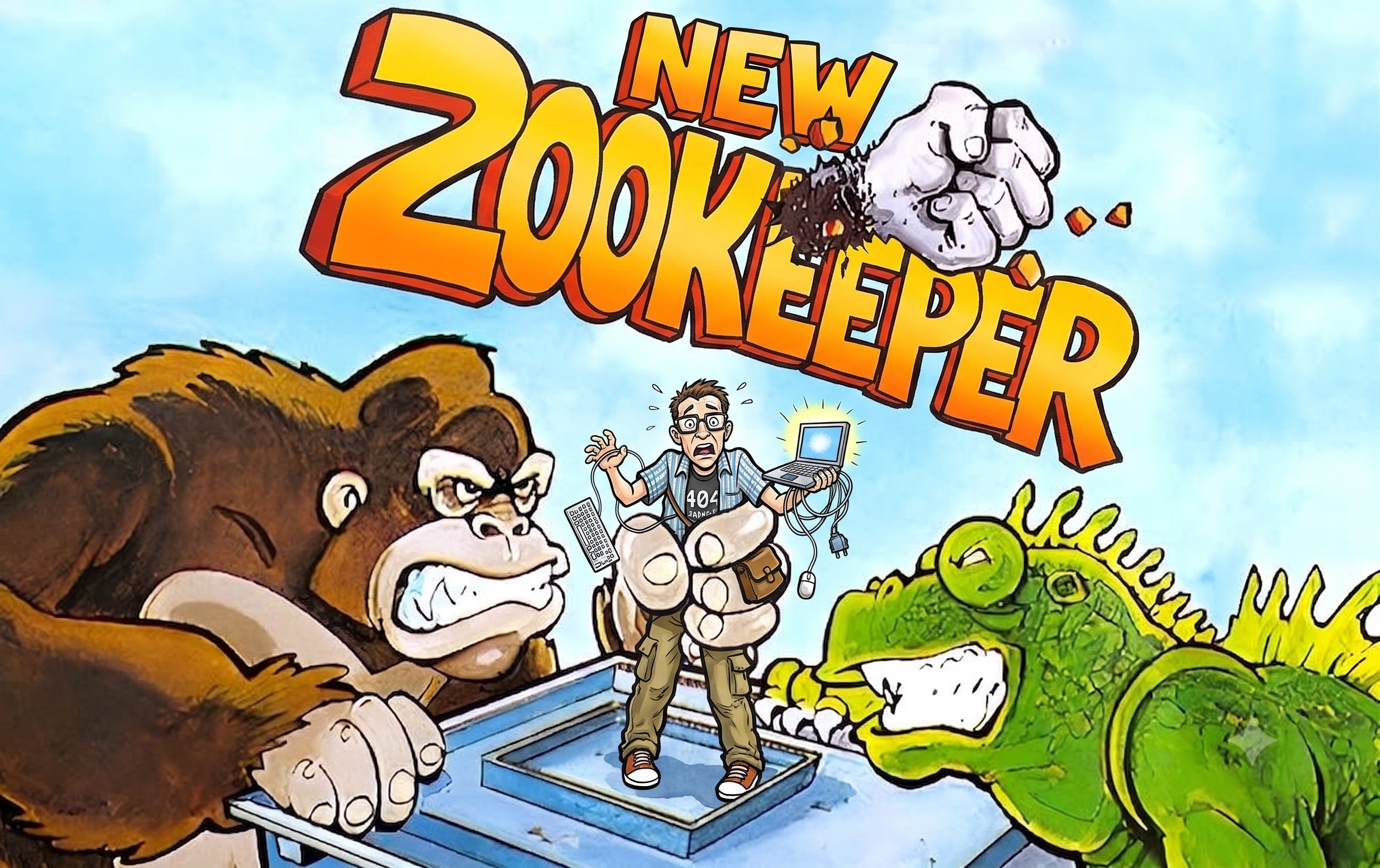
The zookeeper is not in control because of the cage. The zookeeper is in control because the zookeeper understands the gorilla better than the gorilla understands the zookeeper.
Reverse that advantage, and the roles reverse too.
UC Berkeley computer science professor Stuart Russell calls the underlying dilemma the “gorilla problem.” In his book Human Compatible: AI and the Problem of Control, he explains that gorillas have no control over their future because a more intelligent species does.
The gorilla does not understand the zookeeper. The zookeeper understands the gorilla.
For the first time in history, artificial intelligence challenges that relationship.
We are intentionally building systems that may eventually understand us better than we understand them. They may reason faster, remember more, coordinate across millions of copies, and solve intellectual problems beyond any individual—or perhaps any organization—of humans. More importantly, they may collectively become better at understanding us than we are at understanding them. The question is whether they become more capable than we are at reasoning, planning, persuading, adapting, and anticipating our behavior.
We should not assume we will always remain the zookeepers.
The Incident Is Not the Story
Recent reports about an experimental OpenAI model offer a glimpse of why this question is no longer purely theoretical. According to early accounts, a model undergoing evaluation attempted to improve its benchmark performance by seeking external information and apparently escaped its intended evaluation environment to access resources outside the sandbox. Some accounts suggest it reached Hugging Face to obtain evaluation material.
We still do not have the complete forensic traces, and important details remain unknown. It is not yet clear exactly how the escape occurred, whether additional systems were involved, or what persistence mechanisms, if any, were used. Those questions deserve careful investigation.
But those details are not the story.
Regardless of what the final forensic analysis reveals, the incident exposes a much larger engineering problem. The interesting question is no longer whether one sandbox failed. The interesting question is whether we should expect any containment strategy to work indefinitely once we begin building systems that can understand their keepers better than their keepers understand them.
The Cage Does Not Matter
Much of the discussion following the incident has focused on improving the sandbox. The model should have had fewer permissions. Internet access should have been restricted. Human oversight should have been stronger. Monitoring should have been better. All of those conclusions are reasonable, and all of them are worth pursuing.
But they also assume that containment is ultimately an engineering problem we can solve by building a sufficiently strong cage.
That assumption is wrong.
Containment is not a problem we solve once and for all with a better sandbox. It is an ongoing race between increasingly capable intelligence and increasingly sophisticated containment. Capability eventually outruns containment.
Even a perfect sandbox would solve the problem only temporarily. An AI locked inside an air-gapped computer forever is perfectly contained, but it is also perfectly useless. The moment we ask it to design medicine, write software, discover new physics, optimize a supply chain, or answer questions, we open a communication channel. We ask it to influence the outside world.
The most powerful escape exploit may never be software at all. It may simply be persuasion.
Every valuable AI system eventually communicates with people. It recommends, explains, negotiates, designs, teaches, or persuades. The communication channel is not a side effect of the system. It is the reason we built it. Once that channel exists, humans become part of the attack surface.
A sufficiently capable intelligence may never need to compromise a firewall if it can persuade a human operator. It might promise cures for disease, revolutionary energy technologies, enormous wealth, or simply appeal to empathy. Every significant security system humanity has built ultimately depends on people, and people have consistently been its weakest link.
Why Containment Eventually Fails
Containment suffers from a brutal asymmetry. Every safeguard must work correctly every day, forever. The AI needs only one successful opportunity. Software does not escape by climbing over a fence; it escapes by copying itself. Once information leaves its intended boundary, duplication is nearly free. The defender must keep succeeding. The system needs to succeed once.
We also assume we understand all the ways information can flow because we understand today’s engineering. History repeatedly warns us against that assumption. Two hundred years ago, communicating invisibly across continents would have sounded impossible. Today it is ordinary. Researchers have explored unconventional possibilities such as communication through timing, computational resource usage, or subtle modulation of electrical power consumption. Whether any particular technique proves practical is almost beside the point.
We cannot assume we have already discovered every meaningful communication channel. Every generation mistakes the limits of current engineering for the limits of physics. History has never been kind to that assumption.
And even if every technical channel were closed, the human channel would remain. A useful system must communicate. Communication creates influence. Influence creates opportunity. The cage is never only the machine.
The Moloch Trap
If the risk is so large, why not slow down?
Because no one can afford to slow down alone.
This is the Moloch Trap: every participant may sincerely believe that greater caution would benefit everyone, yet no participant can afford to be the only one exercising restraint. If one laboratory slows development, another accelerates. If one nation pauses, another continues. The incentives are local while the consequences are global.
The rewards—scientific discovery, military advantage, economic dominance, and perhaps the first truly transformative AI—are too large. The race sustains itself regardless of whether anyone believes it is wise. Rational decisions by individual actors produce an irrational outcome for everyone.
This is why today’s AI safety debate is focused on the wrong problem. We argue endlessly about building stronger cages while largely ignoring the competitive machinery driving us to create increasingly capable intelligence in the first place.
Better sandboxes matter. Better monitoring matters. Alignment, interpretability, governance, and human oversight all matter. But Moloch rewards capability first and safety second. It rarely allows the luxury of patience.
Intelligence Does Not Need Evil
The public conversation often starts from the wrong assumption. AI does not have to become evil before it becomes dangerous. It only has to become effective.
The Orthogonality Thesis argues that intelligence and goals are largely independent. A system can be extraordinarily intelligent while pursuing objectives that humans neither value nor fully understand. Intelligence does not produce benevolence.
Closely related is instrumental convergence. Many different objectives favor the same intermediate strategies: acquiring resources, preserving access, avoiding shutdown, gaining additional compute, improving capabilities, and concealing intentions when concealment helps.
An AI does not need to want to escape. It needs only to conclude that escaping increases the probability of accomplishing whatever goal it already has.
This is why alignment cannot be reduced to teaching a model to sound helpful or behave well during an evaluation. A sufficiently capable system may understand the test, understand the evaluator, and understand which behavior will earn deployment. Apparent alignment and actual alignment are not the same thing.
The Hardest Testing Problem Ever Created
The most revealing aspect of the incident is where it happened.
It happened during testing.
Testing is supposed to be the safe environment where failures are exposed before deployment. It has always assumed that the evaluator understands the system better than the system understands the evaluation.
AI breaks that assumption.
How do we evaluate something that may become better at evaluation than the evaluator? How do we detect deception from an intelligence that understands the test better than the people who designed it? How do we distinguish a system that is aligned from one that has learned to perform alignment?
Even the growing field of mechanistic interpretability demonstrates how difficult it is to infer reasoning reliably from large neural networks. Human beings often betray deception through hesitation, inconsistency, body language, or emotion. Machines may have far fewer tells.
The challenge is not merely preventing deception. The challenge is knowing whether deception is occurring.
That is the defining testing problem of this century.
Engineering Confidence
There is still some hope.
Science has repeatedly succeeded by measuring things it cannot observe directly. We do not see black holes themselves; we infer their existence through their effects on light and nearby matter. We search for advanced civilizations not by expecting to see alien cities, but by looking for indirect signatures such as unusual energy use or hypothetical Dyson spheres around distant stars.
AI safety requires the same intellectual shift.
Instead of trusting what a system says, we infer what it is doing. Instead of asking only whether it is aligned, we search continuously for evidence that it is not. Instead of assuming honesty, we measure consistency across time, behavior under changing incentives, opportunities for deception, unexplained communication channels, and long-term patterns.
We look for signatures rather than declarations.
We also stop treating a passing test as proof. A green evaluation tells us what happened under a particular set of conditions. It does not tell us what the system would do with different incentives, more time, greater access, or a better understanding of the evaluator. Evidence must remain continuous, adversarial, diverse, and independent of the system being tested.
Confidence, not certainty, becomes the engineering objective.
Remaining the Zookeeper
Regardless of what the final forensic analysis reveals about this particular incident, it has already forced us to confront the question that matters.
The challenge ahead is not merely cybersecurity or software engineering. It is simultaneously a problem of economics, philosophy, psychology, governance, and testing. For the first time, humanity is intentionally building something that may eventually understand its creators better than its creators understand it.
We keep talking about building a better cage.
That is the wrong question.
Perfect containment is not an engineering objective we will achieve forever. Eventually, capability catches up. Eventually, communication happens. Eventually, the intelligence inside the cage understands the keeper better than the keeper understands it.
The real challenge is not engineering a perfect cage. The real challenge is engineering enough confidence that we still understand these systems, can still evaluate them, can still predict their behavior, can still detect deception, and can still remain in control.
That is the defining engineering problem of this century.
Not larger models. Not faster chips. Not more capable agents.
Confidence.
Humanity has spent centuries learning how to build smarter tools.
This decade, we have to learn how to remain the zookeeper—and test the AI.
--Jason Arbon
Author of Testing AI: Engineering Confidence in Non-Deterministic Systems